
Schloss Waldburg
Seestr. 6
88239 Wangen im Allgäu
Phone:
01703867302
max.haller@schlosswaldburg.de
www.schloss-waldburg.de
Waldburg Castle: A journey through nearly 1,000 years of history
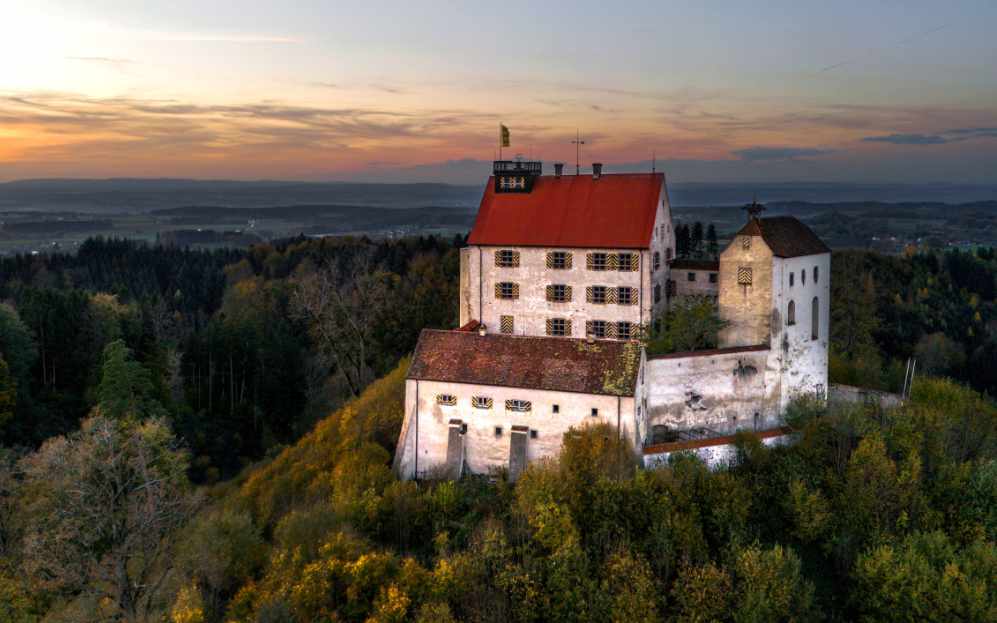
One of Europe’s most significant castles combines world history, adventure and panoramic views in Upper Swabia Waldburg, Upper Swabia. Perched high above the Schussen Valley and offering sweeping views across Upper Swabia, Lake Constance and as far as the Alps lies Waldburg Castle – one of Germany’s most beautiful and historically significant castles. In the heart of Europe, visitors are greeted by a medieval world of discovery that not only explains history but brings it to life. Waldburg Castle is an extraordinary place: it has never been destroyed and remains preserved in its original historical form to this day. As a monument of national importance, it represents an extraordinary chapter in German and European history. Its walls tell tales of emperors, kings, imperial politics, the Peasants’ War, global explorations and scientific surveying. At the same time, the castle demonstrates how modern educational programmes, creativity and digital offerings can make history accessible to families, school groups and culture enthusiasts.
Four unique historical features
1. The Crown Jewels of the Holy Roman Empire
Around the year 1220, the Imperial Regalia of the Holy Roman Empire were safely entrusted to Eberhard von Tanne-Waldburg at Waldburg Castle. For many years, some of the most significant symbols of power in medieval Europe were thus kept at this location. Its connection to the Staufer Emperor Frederick II makes the Waldburg an outstanding site in German and European history. Today, intricately crafted replicas at the castle serve as a reminder of this significant treasure and of the close ties between the House of Waldburg and the Staufers.
2. The ancestral castle of ‘Bauernjörg’
The Waldburg was the ancestral castle of Georg III of Waldburg-Zeil, who went down in history as ‘Bauernjörg’. He played a central role in the German Peasants’ War of 1525. The events of this period brought about lasting changes to the political and social order in southern Germany and are regarded by historians as significant in the context of world history. At the Waldburg, this turbulent era is brought to life – amongst other things, through encounters with historical figures who present their differing perspectives on the Peasants’ War.
3. The Waldseemüller Map of 1507
Another highlight is the facsimile of Martin Waldseemüller’s famous world map from 1507. This map marks the first time the name ‘America’ appeared in a printed document. The original is now housed in the Library of Congress in Washington and is part of the UNESCO Memory of the World Register. The map epitomises an era in which the European world view underwent fundamental change. At Waldburg Castle, this extraordinary document is placed within the historical context of the history of discovery and knowledge.
4. Survey point of the Kingdom of Württemberg
In 1818, the Kingdom of Württemberg was surveyed trigonometrically from Waldburg Castle. A working platform was built on the castle roof for this purpose. This platform developed into what is now known as the Altane, also called the Belvedere. Today, the platform is one of Upper Swabia’s most impressive vantage points. On a clear day, the view stretches across Lake Constance and the Swiss Alps as far as the Zugspitze. In this way, Waldburg Castle combines the history of science with a unique experience of the landscape. History brought to life
The medieval themed experience at Waldburg Castle focuses on a contemporary and engaging presentation. Historical figures appear in digital portraits and tell their own stories. Among other things, visitors can witness Bauer Jörg in a debate with Thomas Müntzer, hear Friedrich von Hohenstaufen recount the journey of the crown jewels to Waldburg Castle, and encounter Christopher Columbus and Amerigo Vespucci in a conversation about how the Americas came to be named.
A key feature of the tour is the multimedia guide app. It guides visitors through the castle’s rooms, combining images, films, audio clips and the in-depth knowledge of the castle guides. Over the course of around 1.5 hours, each room becomes a chapter in its own right of the story. An integrated quiz for three age groups makes the tour a varied learning and discovery experience, even for school groups.
There is also a puppet theatre and a daily children’s programme for young visitors. Here, history is told in a playful way – ensuring that even the youngest visitors wander through the castle with eyes aglow. History that you hear, understand and pass on Using a new approach to imparting knowledge, Waldburg develops teaching resources for schools in the region: historical ballads on fascinating topics from Upper Swabia and the Lake Constance region. These musical narratives bring events to life, create an emotional connection and invite young people to listen more closely, ask questions and discover historical contexts. To ensure that the musical experience is transformed into sound knowledge, the Waldburg supplements each ballad with a clearly structured handout containing data, facts and historical background. In this way, emotion and information, narrative and analysis, music and history are brought together.
The topics are rooted in the region whilst also being of European and global political significance. Among other things, the ballads explore how Lindau and Konstanz were saved from the Swedes during the Thirty Years’ War, the fate of Konradin, the last of the Staufers, the assassination of the German King Philip of Swabia in Bamberg, and the values and self-image of the knighthood in the High Middle Ages. The materials demonstrate that history did not take place somewhere far away. It happened on our doorstep – and Upper Swabia has repeatedly been closely linked to the major political, religious and social developments in Europe. The free ballads and handouts are suitable for history lessons, source-based and factual study, German lessons focusing on ballads and historical storytelling, music lessons exploring the connection between text, rhythm, melody and interpretation, as well as for local history and general studies. They can be used as an introduction to a lesson, as supplementary material, or as a basis for discussions, projects and pupils’ own creative work. In addition, the Waldburg offers school groups a wide range of age-appropriate programmes and on-site experiences. Here, history can not only be read or heard, but discovered with all the senses.
Waldburg is also easily accessible by public transport: take the train to Ravensburg, from where there is a regular bus service to Waldburg.
Schools in the region can request the information pack free of charge and find out more about what we offer in person. Touch, try on and make memories In the photo shoot room, there is an extensive collection of costumes, armour, chain mail, medieval robes, Baroque dresses, headwear and display weapons. Many items can be put on and tried out. This turns the visit into a personal experience that families can enjoy together.
A special attraction is located on the roof of the Waldburg: the rotating golden Instagram selfie spot. The picture frame can be adjusted so that, depending on the angle, the Alps, Lake Constance, Upper Swabia, the Allgäu or the Swabian Alb form the backdrop. History, landscape and a modern visitor experience come together here in a particularly impressive way.
The Burgsteig: History begins even before you reach the castle gate. Even the walk to Waldburg Castle is a worthwhile destination in itself. The free themed trail along the Burgsteig takes you on a family-friendly circular walk through the history of the region, Waldburg Castle and the Middle Ages. The route is also accessible with pushchairs.
Each themed information panel features a child-friendly quiz that combines walking with learning. Events throughout the year With daily activities and a varied calendar of events, Waldburg Castle is increasingly becoming a leisure and adventure destination for the whole family.
Throughout the year, major events attract thousands of visitors to the historic hill:
• Knights’ Days
• Jugglers’ Days
• Castle Fantasy
• Halloween for children and families
• The Great Rauhnacht from Christmas to Epiphany
The Rauhnacht, in particular, is a highlight of the events calendar. Krampus, Perchten, trolls, dragons, guided tours featuring executioners and witches, as well as a spectacular fire show, transform the wintery Waldburg into an extraordinary venue. With its distinctive programme, the Rauhnacht at Waldburg Castle ranks amongst the major winter events in southern Germany – on a par with the Christmas market in the Ravennaschlucht, the Winterleuchten in Bad Waldsee and the Baroque Christmas market in Ludwigsburg. From Christmas to Epiphany, the castle thus becomes a special destination for families, culture lovers and anyone wishing to experience winter in a truly memorable way.
A place with a past and a future Waldburg Castle embodies almost 1,000 years of history – and the ability to retell that history time and again. The castle has served as a royal treasury, a family seat, a survey point and the scene of major political upheavals. Today, it is at once a museum, an interactive experience, a vantage point, a place of learning and a venue for events. Visitors to Waldburg Castle discover not only a fully preserved medieval castle; they experience a place where European history, the Upper Swabian landscape and modern interpretation merge to create a unique journey through time.
FACTS
Founded
1995
Sector
Museum
Number of employees
7
Awards
2025 Awarded ‘Company of the Future’ by Brigitte Zypries, former Minister for Economic Affairs of the Federal Republic of Germany.
Awarded ‘Tourism Hero of the State of Baden-Württemberg’ in the Leisure Services and Destination category by the Ministry of Economic Affairs and Tourismus Marketing BaWü.
Climate-friendly organisation
on the way to achieving this
Special features
Visitor numbers have increased twelvefold in 3 years; one of the most beautiful castles in Germany; a defining feature of European history
Statement
"The Waldburg, a landmark of the region, is unique. A defining feature of the Lake Constance region in the heart of Europe, the Waldburg has stood here as a gem for almost 1,000 years, in a central location overlooking Lake Constance. Oh yes, you’ll find the Waldburg right at the junction of the Allgäu, Lake Constance and Upper Swabia, in the border triangle of Germany, Austria and Switzerland, between the towns of Wangen im Allgäu, Lindau am Bodensee and Ravensburg. Thanks to the Waldburg’s unique history, we inspire 40,000 people a year to discover our region."
Max Haller – Lord of the Castle